
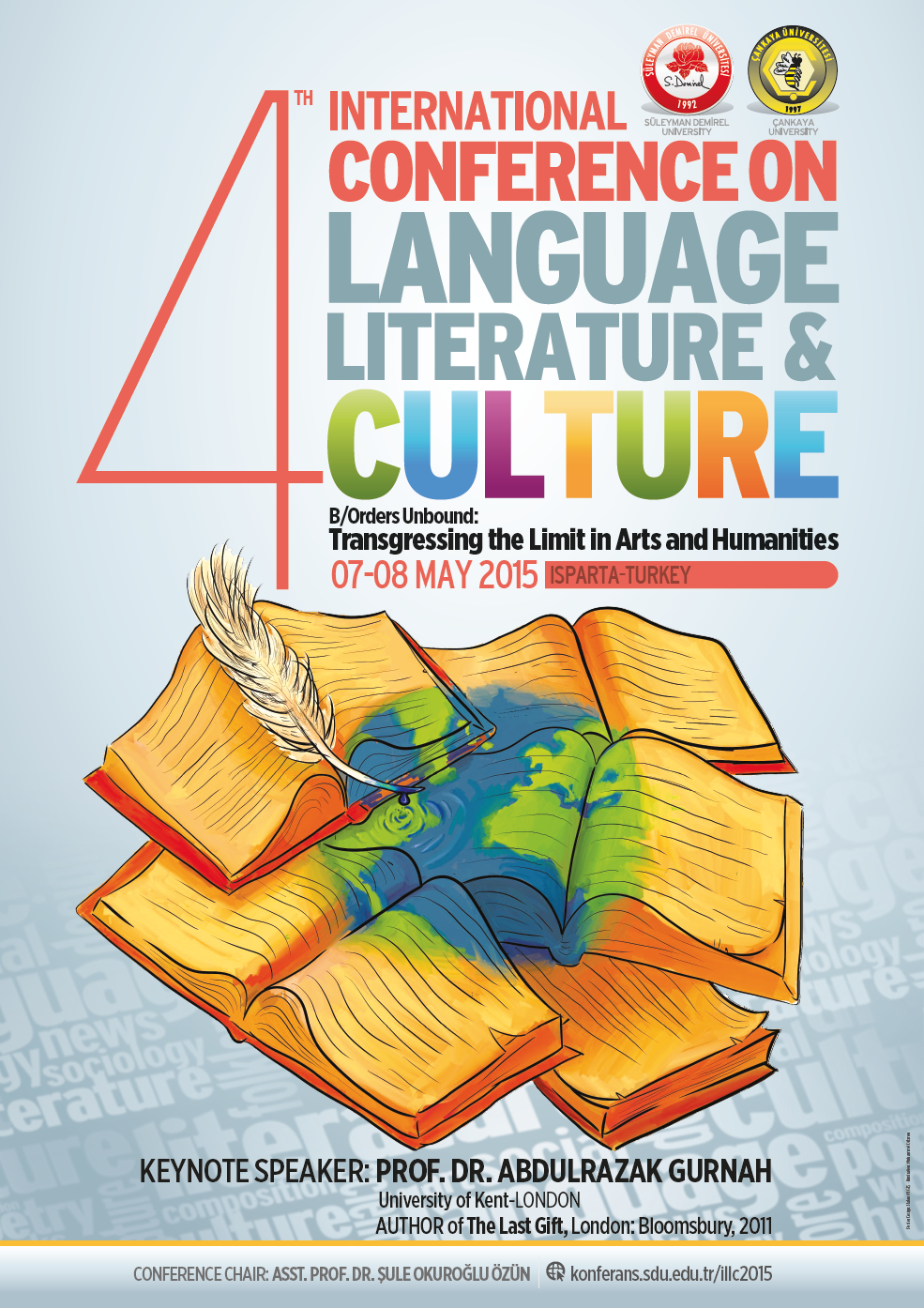
 We are pleased to announce “International Conference on Language, Literature, and Culture B/OrdersUnbound: Transgressing the Limit in Arts and Humanities 7-8 May 2015″ jointly hosted by Cankaya University and Suleyman Demirel University. This International Conference is an annual academic event organized by Cankaya University in Ankara. This year it will be organized jointly and will be hosted by Suleyman Demirel University (Isparta, Turkey). This two-day conference seeks to bring researchers, scholars and students from all areas of language, literature, culture and other related disciplines together at Suleyman Demirel University in Isparta. You may participate as panel organizer, presenter of one paper, chair a session or observer. A 300-word abstract for a 20-minute paper should be submitted as an email attachment to suleozun@sdu.edu.tr.
Selected papers will be published in a volume.
Attached please find the conference details also available at mtb.cankaya.edu.tr/conferences
You can reach further details at http://konferans. sdu.edu.tr/ illc2015
Professor Abdulrazak Gurnah will be our keynote speaker. From 1980 to 1982, Gurnah lectured at the Bayero University Kano in Nigeria. He then moved to the University of Kent, where he earned his PhD in 1982. He is now a Professor and Director of Graduate studies there within the Department of English. His main academic interest is in postcolonial writing and in discourses associated with colonialism, especially as they relate to Africa, the Caribbean and India. He has edited two volumes of Essays on African Writing, has published articles on a number of contemporary postcolonial writers, including V. S. Naipaul, Salman Rushdie and Zoe Wicomb. He is the editor of A Companion to Salman Rushdie (Cambridge University Press, 2007). Gurnah has supervised research projects on the writing of Rushdie, Naipaul, G. V. Desani, Anthony Burgess, Joseph Conrad, George Lamming and Jamaica Kincaid.
Call For Papers
English studies have flourished like rhizome involving a wide range of theoretical framework from different disciplines like education, linguistics, psychology, sociology, folklore and anthropology, translation studies, cultural studies, communication, teaching and learning pedagogy, politics etcetera, thereby making its growth in multiple axes. This experience of a plurality of contact zones creates spaces of liminality that are relational and at the same time open to the questioning of any kind of borders for the interdisciplinary approach. Avtar Brah defines borders as “arbitrary dividing lines that are simultaneously social, cultural and psychic; territories to be patrolled against those whom they construct as outsiders, aliens, the Others; forms of demarcation where the very act of prohibition inscribes transgression” and spaces in which “claims to ownership” are contested, “defended and fought over” (194). Borders are more than lines cutting across maps; rather, they are wide swaths of ambiguity and reversibility where all essentializing distinctions and discourses are broken down and reassembled.
The theme of border opens a space for numerous inquiries and conversations about the things that constitute our borders – socially, psychologically, politically, culturally, academically, etc. – as well as the ways in which those borders are constructed, deconstructed, crossed, challenged, circumvented, diminished and redrawn. The theme also encourages us not only to think about our borders but also to think across them in the hopes of opening spaces for dialogue and disagreement that may in turn amend our sense of these borders.
“International Conference on Language, Literature, and Culture – B/Orders Unbound: Transgressing the Limit in Arts and Humanities” intends to blur the limits of conventional discourses and approaches, and features densely theoretical and analytical writing that focuses on the aspects of English language and literature in any or all possible contexts, employing interdisciplinary approach to address / approach the research problems with methods of and insights borrowed from multiple disciplines.
The aim of the conference is to bring together researchers, scholars and students from all areas of language, literature, culture and other related disciplines. You may participate as panel organizer, presenter of one paper, chair a session or observer.
All submissions to the conference will be reviewed by at least two independent peers for technical merit and content. Topics of interest for submission include, but are not limited to:
- Diasporic Literature
- Nation and Nationality
- Poetry and Prose
- Drama and Dramaturgy
- Contemporary Literature
- Media
- Classical Literature
- Medieval and Renaissance Literature
- Literature and Other Arts
- Literature and History
- Language, Power and Ideology
- Language Varieties
- Literary Criticism
- Critical Race Theory
- Language, Identity and Culture
- Language and Popular Culture
- Literature and Film
- Language and Power
- Language and Gender
- Language and the New Media
- Language, Culture and Translation
- Women’s Writings
- Teaching of Language and Literature
- Teaching and Learning of English as a Foreign/ Second Language
- Effective Teaching Methodologies in Language and Literature Classrooms
- Interdisciplinarity in Language Teaching and Learning
- The Knowledge Base of Language Teacher Education
- Social, Cultural, and Political Contexts of Language Teacher Education
- Collaborations in Language Teacher Education
- Practices of Language Teacher Education
- The transformative nature of the role of language and communication in human cognition
- The analysis of language and language use as providing a window into non-linguistic cognitive processes and structures
- Language, linguistic and speech resource development
- Evaluation methods and user studies
- Machine learning for natural language
- Text analysis, understanding, summarization and generation
- Text mining and information extraction, summarization and retrieval
- Text entailment and paraphrasing
Important dates/information:
A 300-word abstract for a 20-minute paper should be submitted as an email attachment to languageliteratureandculture@gmail.com or suleozun@sdu.edu.tr. In your email, please include your name, affiliation, email address, phone number, title of the paper, and a brief bio data.
All participants are requested to complete the registration form and return it via electronic mail to languageliteratureandculture@gmail.com or suleozun@sdu.edu.tr until April 25, 2015.
Selected papers will be published in a volume.
Should you need further information, please contact the organizers at: languageliteratureandculture@gmail.com or suleozun@sdu.edu.tr